
MiniMax sponsors the festival that certifies China's AI filmmakers
China’s film industry is contracting. Generative AI is getting the blame. Hiring data shows roles multiplying rather than vanishing.
AI editor hiring rose 179% YoY in June, per People’s Daily
Traditional editor postings grew 7% over the same period
Practitioners date the industry contraction to before generative video worked
The festival gate certifying AI filmmakers carries a model vendor’s name
Mandatory labelling since September 2025 marks every AI work at upload
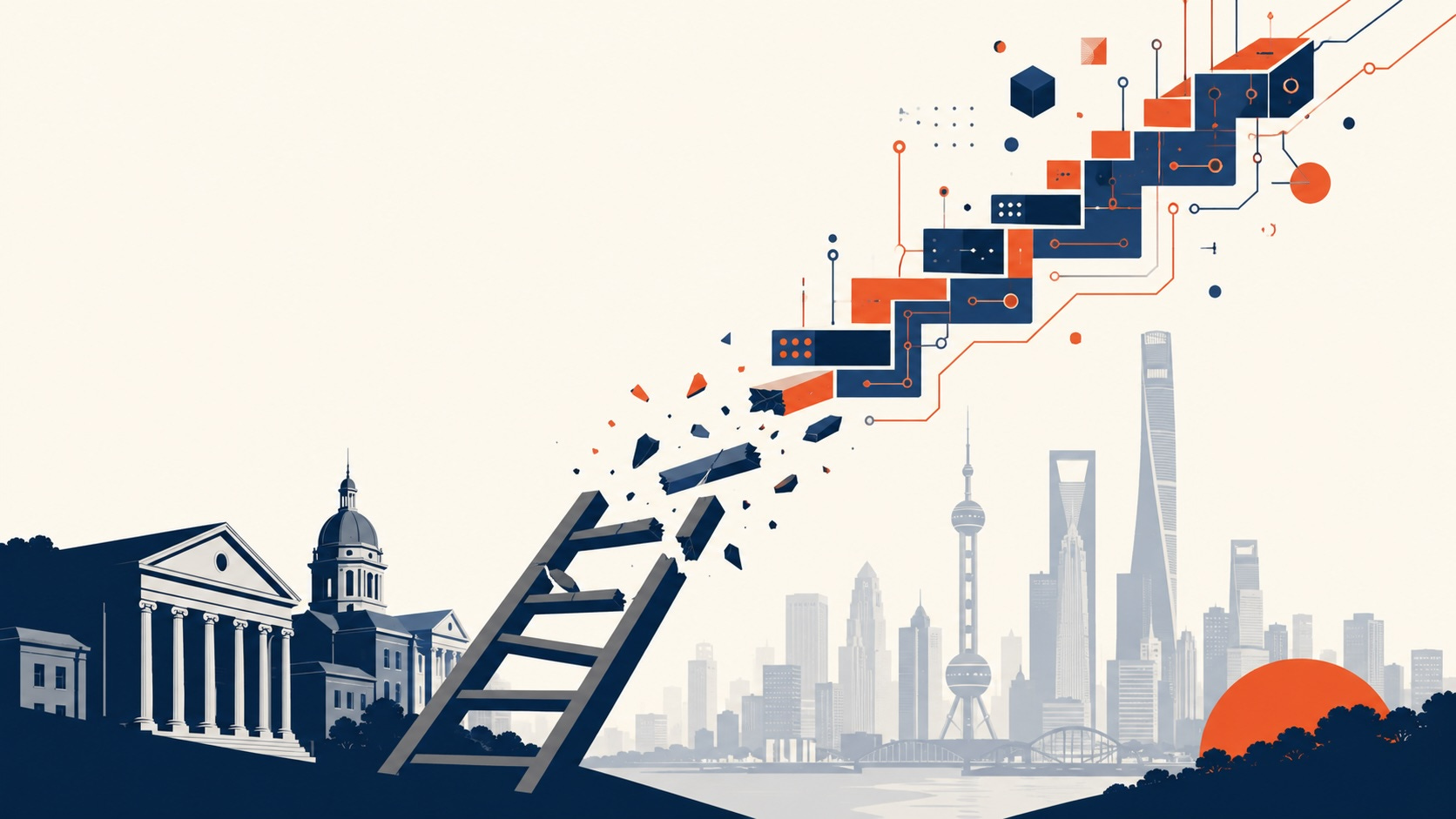
China’s film and television industry ran for decades on a long apprenticeship. New entrants started as script supervisors or production assistants. Practitioners commonly describe a decade of that work before reaching a director’s chair.
The ladder did two jobs at once. Training happened slowly, over years of proximity to working professionals. Screening happened alongside it, thinning each intake cohort at every rung.
Entry began earlier still, at university admission. Applicants to film and media programmes sat the yikao, a specialised arts examination separate from the national gaokao. Candidates submitted portfolios and sat practical tests at individual institutions.
Passing signalled craft aptitude before any professional record existed to judge. Chinese commentary has long treated the yikao as a lower-scoring route into elite universities, which made it socially contested well before AI entered the picture.
Both mechanisms are now under revision. Generative video removed the economic case for the lower rungs of the ladder. No institution has replaced the certification those rungs provided.
China’s film winter started before the tools worked
Read the layoff numbers carefully and the causation reverses.
A senior visual effects practitioner at a leading Chinese studio told Tencent News his company cut roughly 20% of staffaround Chinese New Year. He traced the cuts to a multi-year decline in incoming projects. On AI specifically, his assessment was that film-grade visual effects work remains largely beyond current tools.
A project manager at a well-known production house was more direct. The real contraction long predates AI, according tohis account. He named fewer greenlights, colder investment and sustained pressure on long-form drama. Generative tools function as an accelerant on problems that were already structural.
Storyboarding illustrates the pattern. A leading storyboard artist described the role to Tencent News as a luxury commissioned only by high-budget features, premium series and well-funded commercials. Downturns eliminate it regardless of what technology exists.
The film winter arrived first. AI is being assigned credit for a cycle it did not start.
AI filmmaking jobs are multiplying, not vanishing
The hiring data points in an unexpected direction.
Postings for AI editors rose 179% YoY in June 2026, according to People’s Daily. Demand for conventional editors grew 7% across the same window. Monthly salaries for AI film roles run RMB 8,000 to 20,000, scaled to individual capability.
Note the composition of the new roles. Teams now list AI storyboard artists, AI image generators, AI editors and AI card-pullers. The last title describes trial-and-error generation of clips until usable footage emerges.
Backgrounds are shifting alongside titles. One veteran director’s team includes a cultural relics restoration graduate working as a card-puller. A landscape design graduate handles generated environments on the same production.
Efficiency gains concentrate in specific stages. Visual effects and previsualisation run 3-10 times faster. Short-drama companies report monthly output rising from a handful of titles to close to 100. The People’s Daily report does not disclose the recruitment dataset behind the 179% figure. Its framing is promotional.
Commercial volume is concentrating in short-form rather than features. Kuaishou named AI comic drama one of 3 incremental growth industries for 2026, according to its earnings call. AI-generated material reached 10% penetration of the platform’s short-video marketing spend by March 2026, per the same company.
Feature films attract the festival coverage. Serialised short-form content is where the headcount and the revenue actually sit.
The middle rung disappeared
Project economics at the top end explain why.
Director Chen Xiaoyu is building the AI animated feature The Robot Backpacker with a 10-person team over 3 months. Equivalent traditional 3D animation might require 300 people across 2 years, he estimated to The Paper. He puts productivity gains near 15 times and cost reduction at 10 times or better.
Treat that as one director’s counterfactual on an unreleased film. The direction still matters for anyone modelling creative-services labour.
Headcount per project falls sharply. The skill requirement per remaining head rises in step. Chen’s 10-person team requires every member to handle both 2D and 3D work with independent aesthetic judgement.
Below that sits a high-volume execution tier. Card-pulling, prompt writing and asset generation are learnable in weeks. Pricing sits at the bottom of the RMB 8,000 band.
The middle vanished. Assistant and junior roles were where the industry converted graduates into professionals over several years. Neither the judgement tier nor the execution tier performs that function.
Communication University of China cut 16 majors
China’s leading media university moved before the industry did.
Communication University of China closed, merged or converted 16 undergraduate majors and directions, Party Secretary Liao Xiangzhong confirmed during the March 2026 Two Sessions. Photography, comics, translation, visual communication design and new media art were among them. Traditional photography can no longer stand as an independent discipline, he argued in remarks carried by People’s Daily.
A second announcement followed on 3 August 2026. From 2027, 8 behind-the-camera majors move to general gaokao admission on academic score alone, according to Guangming Daily. Drama and film directing, screenwriting, cinematography and intelligent imaging arts sit on that list.
Sequence matters more than causation here. The university frames the admissions change as implementation of Ministry of Education arts-reform policy, with no AI rationale stated. Several majors including screenwriting had already moved to academic-score admission in 2024.
Eight further majors keep the audition gate, covering acting, hosting, musical theatre and music performance. Peer institutions are moving the same direction. The Central Academy of Fine Arts, Jilin University, East China Normal University and Tongji University have all suspended or restructured arts programmes.
Institutions are withdrawing certification from crafts, not from the industry. The distinction determines where scarcity lands next.
The credential now comes from the toolmaker
Watch what filled the vacuum.
The second World AI Film Festival ran at the Palais des Festivals in Cannes on 21 and 22 April 2026. Gong Li chaired it and designed the trophy. China operates as one of four regional stations alongside São Paulo, Seoul and Kyoto.
The China region drew close to 2,000 submissions, organisers said in materials reported by Tencent News. Judges selected 25 worksto compete for 7 regional honours. Only the top China honoree travels to Cannes for global judging.
The jury carries genuine establishment weight. Shanghai Film Association chair Zheng Dasheng leads it, joined by director Yu Baimei and China Film Association digital production committee vice chair Xie Ning.
Now note who else is in the room. MiniMax subsidiary Hailuo held the festival’s official AI technology partner slot. Hailuo marketed the arrangement with a line about sending creators to Cannes, as documented by TMTPost.
One award category carries the Hailuo name directly. The festival has no connection to the Cannes Film Festival. The Palais is a commercial venue available to any renter.
Vendor involvement extends past sponsorship. Hailuo Video co-produced the widely circulated student film Dance of E-Spark with Communication University of China’s Future Imaging Research Center, per Sina Finance. That account appeared as promotional coverage of the vendor. No independent confirmation of the arrangement is publicly available.
Entry rules close the loop. Submissions must integrate at least 3 generative AI tools, including at least one image generator, according to WAIFF.
The playbook did not originate in China. OpenAI partnered with Tribeca on Sora Shorts in 2024, which TMTPost identifies as the source of the model.
A model vendor now supplies the tool, co-produces the work, sponsors the festival and names the prize. The certification a young filmmaker earns is issued by a party with a commercial interest in the outcome.
What an AI film credential costs to hold
Three constraints bind holders of it.
