
Digital consumption hit RMB 9.37T in H1 2025, equal to 46.5% of total resident spending.
Digital services are outpacing physical goods and remain structurally underpenetrated.
Online food delivery and travel each crossed RMB 1T, confirming services as the next structural growth driver.
958M digital consumers represent 68.1% of China’s population, a near-saturated base shifting focus to spend depth.
The key investor question: which services categories capture the remaining conversion upside.
China’s digital economy is typically framed as a technology story. The CNNIC Digital Consumption Development Report for 2025 is based on a 30,000-respondent survey across 31 provinces. It reframes China’s internet economy as a structural consumption story.
CNNIC has tracked China’s internet economy since 1997. Its annual reports are among the most comprehensive primary datasets on Chinese digital behavior available to international researchers and investors. The H1 2025 edition is notable for one number above all others: 46.5%.
That is the share of total resident consumption now flowing through digital channels. At RMB 9.37T, it is not a rounding error or a pandemic-era distortion. It is a durable structural threshold that changes the baseline assumptions for China consumer analysis.
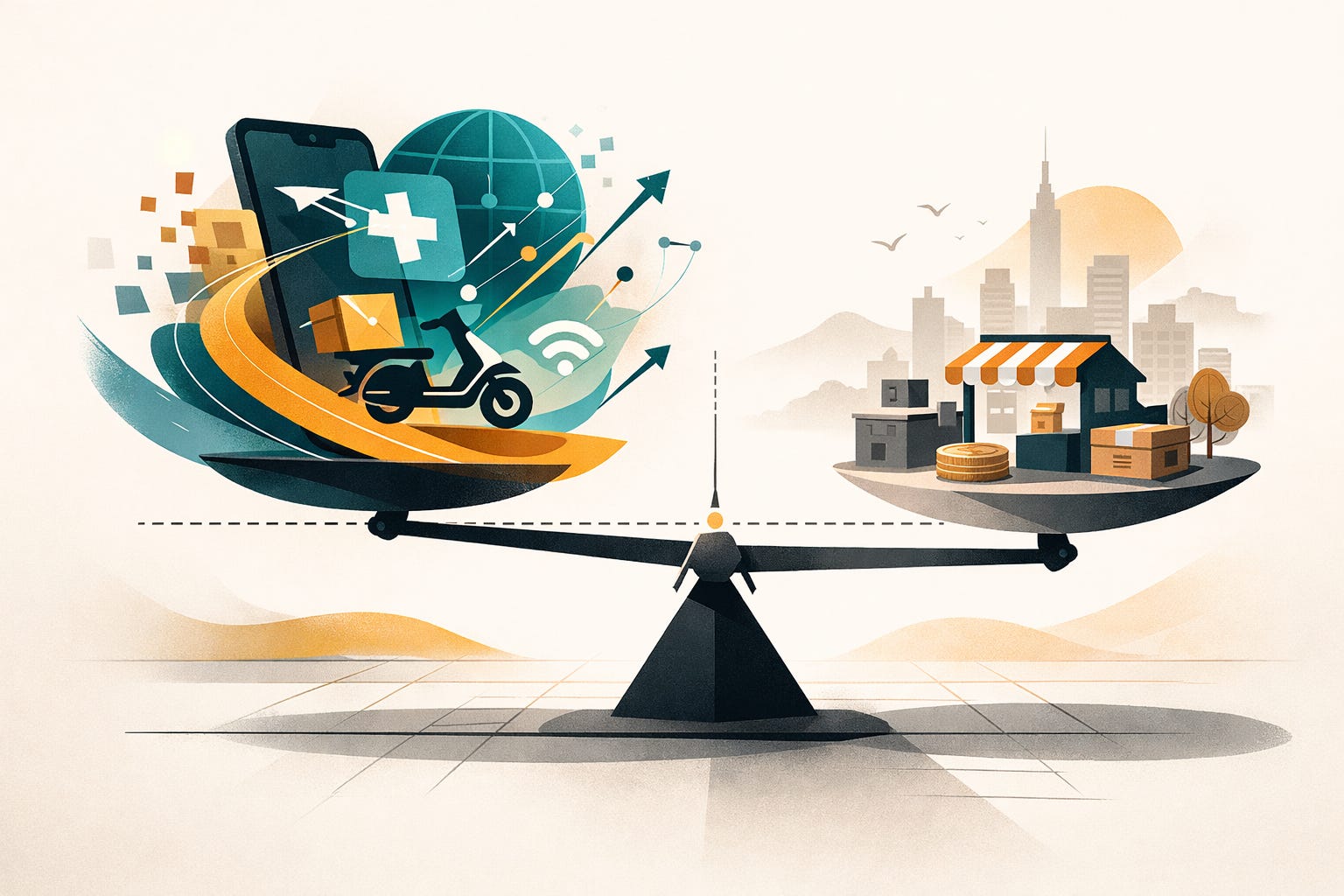
Read the rest of the series on China’s digital economies in 2026:
How AI and Elderly Demographics Created China’s Most Profitable Micro-Drama Tier
China’s elderly digital consumers defy the low-value assumption
Is 46.5% a floor or ceiling?
The 46.5% figure deserves decomposition before interpretation. The RMB 9.37T total breaks into three categories: physical goods bought online (66.3% of digital consumption), digital services (29.2%), and digital content (4.5%).
Physical goods online penetration is mature. The growth rate is decelerating toward its natural ceiling as offline retail stabilizes at its residual share. That category’s trajectory is largely set.
The services share is the more important signal. At 29.2% of digital consumption, digital services remain structurally underpenetrated relative to their physical goods counterpart. Food delivery, travel booking, healthcare, education, and home services are all digitizing at different speeds.
The policy architecture in 2025 is explicitly designed to accelerate this transition. The 46.5% threshold will rise. The increment will come almost entirely from services, not goods. Analysts modeling China consumer exposure using physical retail metrics are measuring the wrong variable.
Services crossed RMB 1T. Twice.
The clearest evidence of the services shift sits in two category-level numbers. Online food delivery reached RMB 1.09Tin consumption value, serving 569M users. Online travel and transportation reached RMB 1.08T, serving 514M users.
Both categories crossed the trillion-renminbi threshold in a single reporting period. Neither number was widely anticipated at the scale or speed at which it materialized.
Food delivery is the more structurally interesting case. The RMB 1.09T figure captures more than transaction volume. It reflects the digitization of daily household expenditure.
When food delivery crosses a trillion renminbi in semi-annual consumption, it signals that digital channels have captured a category previously considered offline by default.
Travel digitization at RMB 1.08T reflects a different dynamic: the recovery of deferred consumption combined with platform consolidation. Trip.com Group,
Meituan’s travel vertical, and Fliggy (Alibaba) have collectively built infrastructure that now intermediates the majority of domestic travel booking. The trillion-renminbi figure is as much a platform concentration story as a consumption story.
Together, these two categories account for over RMB 2T of digital services consumption in a single half-year. That is larger than the entire digital consumption base of most economies.
The user base is near-saturated. Spend depth is the new metric.
958M digital consumers is the headline user figure from the CNNIC report.
That is 68.1% of China’s population engaging in digital consumption. Total internet users reached 1.123B. The gap between internet penetration and active digital consumption participation stands at approximately 165M.
Those 165M are disproportionately elderly, rural, and lower-income. Converting them to digital consumers is both a policy objective and a commercial opportunity. It is a long-cycle project. The near-term growth story is not acquisition. It is spend depth.
Three metrics now drive platform revenue growth and consumer brand margins: average spend per digital consumer, category breadth per household, and services penetration among existing users. The 958M user base is mature enough that marginal user acquisition has diminishing returns in most categories.
Why it matters for investors: Consumer sector equity positions in China priced on user growth assumptions are measuring the wrong variable. The correct metrics are average revenue per user, category cross-sell rates, and services attach rates on existing physical goods transactions.
Policy as accelerant: trade-in programs and infrastructure build-out
The RMB 2.9T in sales driven by government trade-in subsidy programs in H1 2025 is the most direct evidence of policy transmission into digital consumption. The programs, covering appliances, consumer electronics (3C), and vehicles, were structured to route purchases through digital channels.
