
China’s stock-exchange restaurants spread to 10+ cities in months
Exchange-style dining boomed on social media across China. The dynamic pricing is cosmetic. Product depth is thin. Repeat visits are already declining.
Exchange-style dining expanded from Qingdao to 10+ Chinese cities in under 12 months.
Equipment costs for a full setup run 300K-400K RMB. Cost pressure is already forcing downgrades.
Price fluctuations cap at 0-3 RMB per item. The stock-market effect is theater.
Exchange-style dining is a retail format that emerged across China in 2024. Restaurants in this category model their interiors on stock exchanges. Large circular screens display product names, prices, sales volumes, and real-time price movements.
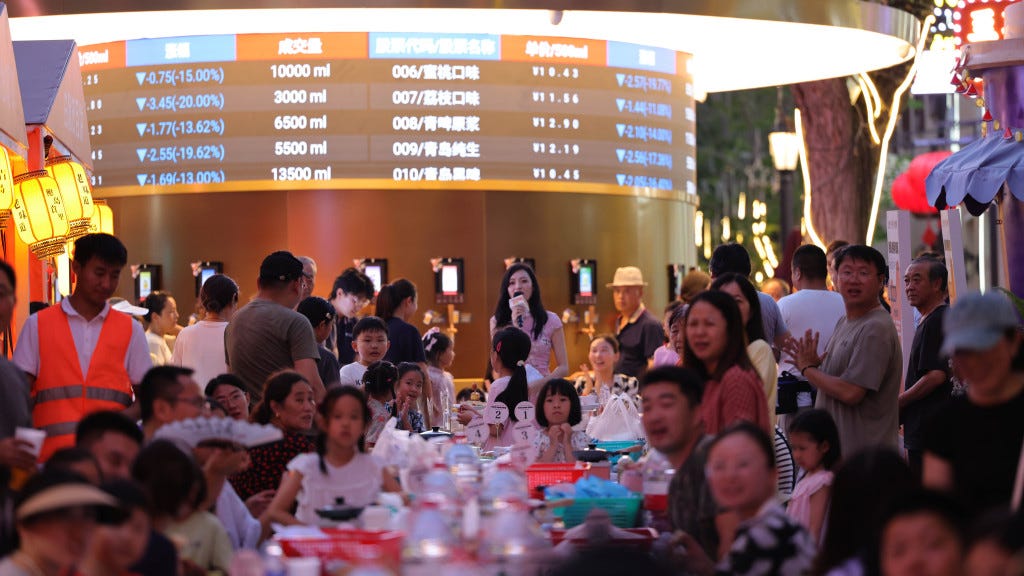
Each item carries its own ticker code. Prices flash red on the way up and blue on the way down, borrowing the visual conventions of Chinese securities markets.
The format originated in the beer category. It has since spread to coffee, bakery products, ice cream, and hot pot. Some operators have woven exchange-style elements into broader dining concepts rather than building entire venues around them.
China’s food and beverage sector has seen a recurring pattern in recent years. Formats that prioritize visual novelty and social media virality over product depth tend to follow a predictable arc. Blind box dining, immersive themed restaurants, and interactive food installations have all followed this trajectory.
Exchange-style dining is the latest test case. Whether it follows the same path depends on one tension: the format’s visual appeal is its strongest acquisition tool. It is also the asset least likely to drive return visits.
For investors and operators evaluating China’s experiential dining market, the format offers an early-stage case study in how novelty economics play out in real time. The data is still early. The trajectory is already visible.
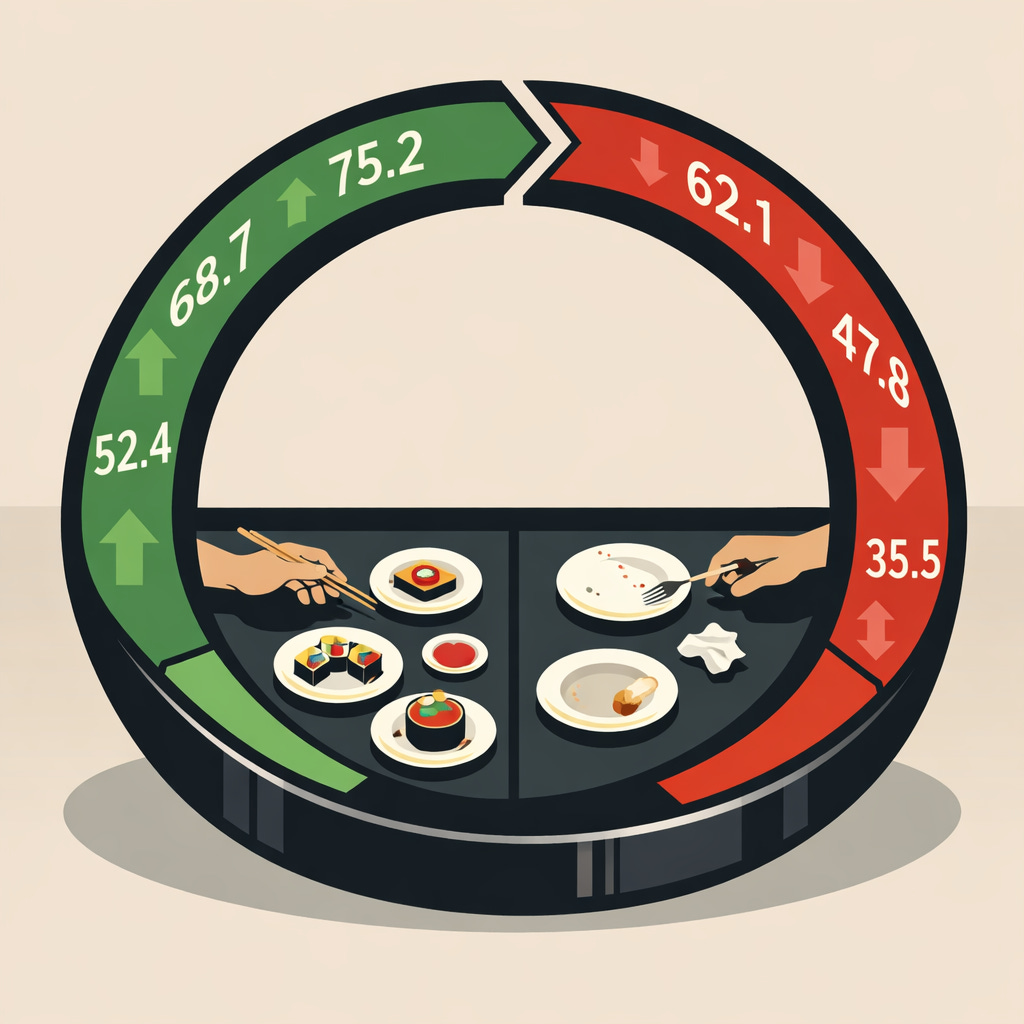
How exchange-style dining spread from Qingdao to 10+ cities
In May 2024, a beer exchange opened on Qingdao’s Tadong pedestrian street. The concept was direct.
A large screen displayed real-time “prices” and “transaction volumes” for each beer on offer. Customers poured their own drinks from smart taps arranged in a circular layout. The format was designed to feel like a trading floor, not a bar.
The response was immediate. According to Hongcan Wang (a Chinese food industry publication), daily footfall exceeded 10K visitors at peak periods. Single-day sales surpassed 2,400 cups, with daily transaction volume reaching 1,200 liters.
On Douyin, topics tagged “beer exchange” accumulated more than 40M views. The format moved from a local novelty to a nationally recognized concept within weeks.
Replication followed quickly. Exchange-style beer venues appeared in more than 10 Chinese cities within months. The spread ran from Harbin in the northeast to Sanya, Guangzhou, and Shenzhen in the south.
Most venues are independent, single-location shops. A small number have begun testing chain formats. Harbin’s Snow Bear Beer Exchange Center, Guangzhou’s Mengmeng Bear Smart Beer Exchange, and Foshan’s Gorilla Beer Exchange each operate 1-4 locations.
The format did not stay in beer. Coffee exchanges adopted the same ticker-screen model. Zhengzhou’s Coffee Exchange lists its products with alphanumeric codes.
Items like SPU001 and SPU002 are priced between 6.6 and 19.9 RMB per 500ml. Bakeries incorporated exchange-style aesthetics by displaying baking schedules on electronic ticker boards. Shanghai’s Wuwei Canba added a wall of self-pour alcohol dispensers with stock-style price displays to its Sichuan and Hunan dining concept.
The format spread because it produces shareable content. A screen full of real-time price fluctuations is inherently photogenic. For operators, exchange-style dining offered something rare in a crowded market: a reason for customers to film and post.
Earned social media visibility of this kind is difficult to replicate through conventional marketing spend. The speed of replication is itself a signal. The format requires no proprietary technology or specialized skill to copy.
Why the initial operator numbers looked compelling
The financial picture painted by early operators was encouraging. Foshan’s Beer Exchange reported daily sales between 1,000 and 3,000 cups, with stronger performance on evenings and weekends. Harbin’s Snow Bear Beer Exchange Center claimed to have broken even within its first month, according to Hongcan Wang.
These figures suggest attractive unit economics on paper. Labor intensity is low because customers serve themselves. Menu complexity is minimal, which keeps preparation costs down.
Marketing is largely organic, driven by social media sharing rather than paid acquisition channels. Customer acquisition costs are rising across China’s food and beverage sector. Self-service formats with built-in viral potential appeared to sidestep that trend entirely.
The proposition appeared straightforward. Combine the margins of a self-service bar with the visibility of a viral trend.
No celebrity chef required. No complex kitchen operation. A screen, smart taps, and a ticker display constituted the entire value stack.
The early numbers capture only the acquisition phase. The harder questions live in the pricing mechanics, the product constraints, and the durability of consumer interest over time.
Why the dynamic pricing is largely cosmetic
The stock-exchange aesthetic is the format’s central hook. The pricing system behind it is thinner than it appears.
Each business day, all products reset to a fixed “opening price.” The system runs a settlement cycle every 10 minutes. If more customers buy a given item within that window, its price adjusts upward for the next cycle.
Fewer purchases push it down. The color coding mirrors the red-and-blue conventions of Chinese stock displays.
The cap is where the mechanism loses credibility. According to Hongcan Wang, fluctuation limits vary by venue but remain narrow. Zhengzhou’s Coffee Exchange and Guangzhou’s Mengmeng Bear each cap price movements at 10%.
Qingdao’s Beer Exchange allows fluctuation of up to 20%. Foshan’s Beer Exchange permits the widest range at 30%. With base prices between 5 and 25 RMB, the actual price change on any item falls within 0-3 RMB.
The dynamic pricing is atmosphere, not economics. Consumer feedback is direct on this point. One visitor to Zhengzhou’s Coffee Exchange noted that the price movements were too small to matter.
The fluctuations create visual activity on the screen. They do not signal genuine demand shifts or serve an inventory-clearing function.
The 10-minute settlement window is too short to create meaningful price discovery. It is long enough to produce the visual impression of a functioning market.
If the pricing system does not meaningfully shape purchasing behavior, the exchange aesthetic offers no operational advantage over a standard fixed-price menu. The ticker becomes decoration.
How self-service caps product quality
Exchange-style dining is structurally tied to self-service delivery. Customers pour their own drinks or select from pre-prepared options.
This keeps staffing costs low and throughput high. It also sets a ceiling on product complexity.
Beer flows from taps. Coffee is predominantly cold brew or pre-mixed liquid. Juices rely on concentrate blending.
According to Hongcan Wang, consumer reviews consistently flag product quality as the format’s weakest point. One reviewer noted that coffee at a local exchange carried no aroma. Juice products had an obvious reconstituted taste.
Freshly ground, pour-over preparation is rare across most venues.
The equipment economics reinforce this constraint. According to a Beijing-based equipment supplier cited by Hongcan Wang, a 9-tap smart dispensing system costs approximately 35K RMB. A 30-tap circular setup with an automated price-fluctuation system runs 300K-400K RMB.
These are significant upfront costs for a single-location venue with no guarantee of sustained traffic. The payback calculation depends entirely on whether foot traffic holds beyond the novelty cycle. Most operators have no historical data to model that assumption.
Some operators have already responded by downgrading. One venue replaced its dynamic pricing screen with a standard illuminated sign, cutting total equipment costs to roughly 50K-60K RMB. The trade-off is decisive. Without the ticker, the venue loses its primary reason to exist as an exchange-style restaurant.
High-volume self-service also accelerates hardware wear. Dispensing systems built for tens of cups per day are being pushed to thousands. Breakdowns become frequent.
Maintenance costs compound over time, eroding the margins that made the format look attractive in early projections.
The repeat-visit problem and first signs of decay
Social media virality can launch a format. Sustaining one requires a different set of dynamics.
According to Hongcan Wang, a Nanjing-based consumer observed that the local beer exchange drew consistent queues during its first two months after opening. As cooler weather reduced seasonal foot traffic, the queues disappeared.
The venue continued to operate. The initial surge of interest did not repeat.
The sharpest data point is a rebranding case. Zhuhai’s “Three Bulls Hot Pot Exchange” styled its menu around beef cuts displayed as K-line charts on a large screen. Daily sales volumes and prices scrolled beneath.
The concept attracted initial attention. By the end of 2024, the restaurant had dropped “Exchange” from its name. It reverted to a conventional hot pot identity.
The exchange format had failed to sustain return visits.
Novelty decay is the format’s central structural risk. Exchange-style dining delivers a strong first-visit experience. The screens are visually striking.
The concept is easy to explain and share. Without a product layer that justifies a second visit, the format functions as a one-time attraction.
The pattern is consistent with previous experiential dining formats in China. Initial buzz drives a surge in first-time visitors. Without a durable product reason to return, the format settles into a niche or disappears.