
DeepSeek gave Beijing the only outside vote
Tencent, CATL, and JD.com got no votes. Beijing got the only outside seat. A new template for Chinese AI, and a new counterparty problem for commercial partners.
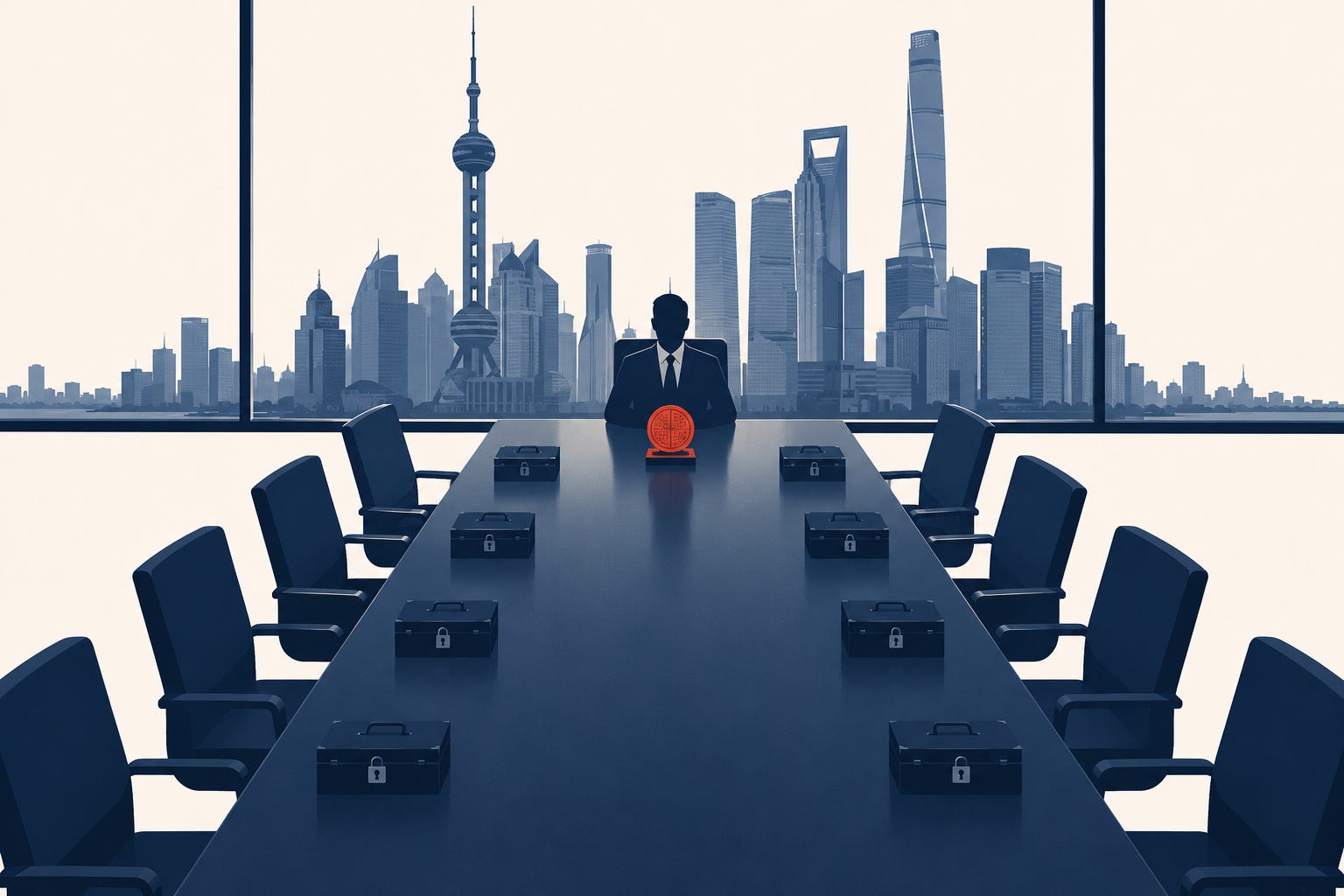
Liang Wenfeng retains roughly 84% control post-round. Tencent, CATL, JD.com, and NetEase received no voting rights.
The National AI Industry Investment Fund is the sole external holder with governance rights and no lockup.
The structure combines LP isolation, secondary lockup, and state-only equity. No Western template maps cleanly.
Talent poaching, not compute shortage, forced the raise. Retention economics drove the terms.
For firms weighing commercial engagement, the effective counterparties are Liang and Beijing.
On June 16, 2026, DeepSeek closed its first external funding round. The raise totaled around 51B RMB, or roughly $7.4B, at a post-money valuation of $52B to $59B, per Reuters and SCMP.
Founder Liang Wenfeng committed 20B RMB personally. Tencent contributed 10B RMB. CATL contributed 5B RMB. JD.com, NetEase, and IDG Capital each committed around 3B RMB. Monolith Capital also participated. The National AI Industry Investment Fund (NAIIF) contributed roughly 1B RMB.
DeepSeek had refused outside capital before this round. Liang’s quantitative hedge fund High-Flyer funded the lab’s entire operating history. The raise ends a five-year policy of “no fundraising, no IPO, no commercialization.” The round is the largest single-round financing in Chinese AI history.
The story is in the count of votes at the table.
The cap table has two tiers
Every commercial investor (Tencent, CATL, JD.com, NetEase, IDG Capital, Monolith Capital) entered a limited partnership controlled by Liang Wenfeng. They hold economic exposure to the fund, not shares in the operating company. Their LP interests are locked for five years, secondary sales barred. They have no voting rights at either the fund or the operating company. Reporters Jing Yang, Qianer Liu, and Juro Osawa at The Information broke the structure on June 15. Silicon UK, citing SCMP’s Beijing-based investor source, confirmed none of the private investors received board seats.
The National AI Industry Investment Fund is the exception. According to Forbes, NAIIF invested directly, received voting rights, and holds no lockup. The state fund is the sole external investor with governance rights and immediate liquidity.
The mechanic sits in an April 27, 2026 corporate registry filing, per Tianyancha data reported by 36Kr and corroborated by BigGo Finance, DigiTimes, and Yicai Global. DeepSeek’s registered capital rose from 10M RMB to 15M RMB. Liang subscribed the new tranche personally. His direct stake moved from 1% to 34%. The remaining 66% sits with Ningbo Cheng’en Enterprise Management Consulting Partnership, which he controls. Combined operating-company control reached roughly 84.29%, before the raise started. External capital then entered through the Liang-controlled LP, which took a minority stake in the operating company.
Most coverage anchored to the $7.4B headline. The structural facts underneath it went unread.
Why Liang raised, and could dictate the terms
The raise had one purpose: retention benchmarking. Talent departures forced Liang’s hand. Per ChinaBizInsider, Luo Fuli, a key V3 contributor, departed to lead Xiaomi’s AI division. Guo Daya joined ByteDance earlier in 2026 at significantly higher compensation.
36Kr reports Wang Bingxuan also left for Tencent during the same window. Per BigGo Finance, the median monthly salary for algorithm roles in China’s 2026 campus recruiting market exceeds 24,000 RMB. Top-tier talent commands over 50,000 RMB per month. Priced options against a formal valuation are how frontier labs retain researchers. Without a round, DeepSeek could not price them.
Because he was not raising for survival, Liang could impose terms. DeepSeek’s V3 and R1 models delivered frontier-class performance at costs reported at a fraction of Western frontier lab budgets.
A lab that does not need capital dictates terms in any negotiation. Liang’s personal 20B RMB check underlines the position. He is the round’s single largest investor.External capital accounts for roughly 60% of the raise. Standard investor pushback loses force when a founder anchors that share of his own round in personal money.
DeepSeek posted 33 open roles ten days after the raise. The round was priced to defend a team, not to build one.
What VIE and dual-class do not do
Founder control in cross-border and public-market structures has long precedent. DeepSeek takes a different form.
Variable interest entities are the standard vehicle for Chinese firms listed on US exchanges. Alibaba, Baidu, and Pinduoduo use them. VIEs preserve founder operational control through offshore holding companies and WFOE contracts. Public shareholders receive economic exposure and proxy voting rights on the listed shell. Governance is attenuated but present.
Dual-class share structures protect founder control in US-listed firms. Alphabet, Meta, and Snap use them. Founders hold supervoting shares while public shareholders hold subordinate voting shares that still carry votes on their tier. Governance is asymmetric, not absent.
DeepSeek’s structure removes both features. Commercial investors are not shareholders. They hold LP interests in a founder-controlled fund. Voting is unavailable at either the fund level or the operating company level. Secondary sale is barred for five years. The state investor receives what a standard venture round would treat as baseline: direct equity and voting rights.
No Chinese peer matches this design either. Alibaba’s post-Ant restructuring, ByteDance’s Cayman holding structure, and Xiaomi’s dual-class Hong Kong listing all preserve some governance path for private capital. None uses an LP wrapper to isolate private capital from company-level equity entirely.
The framing that matters is exclusion, not asymmetry. Alphabet’s public shareholders vote. DeepSeek’s Tencent does not. The structure is a wrapper that terminates governance rights at the fund boundary.
What Beijing’s single vote actually buys
The National AI Industry Investment Fund is a joint venture. Its parents are Guozhi Investment (Shanghai) Private Equity Fund Management and Big Fund Phase III, the third iteration of China’s state semiconductor investment vehicle, per Silicon UK.
Big Fund Phase III is the largest of the three state chip investment tranches launched since 2014. Its mandate is upstream semiconductor capacity. It has backed SMIC and YMTC. Its participation in DeepSeek is the first time the Big Fund has taken equity in an LLM company, per 36Kr.
Beijing holds the only external seat at China’s most globally consequential AI lab. Two implications follow.
First, state governance is direct. It covers the model roadmap, licensing decisions, and international commercial deals. Beijing does not route influence through Tencent or CATL as proxies. No private coinvestor holds veto capacity to counterbalance.
Second, foreign data-access and use-restriction concerns will intensify, as Forbes flagged within days of closing. DeepSeek already faces restrictions in some jurisdictions and inside some private companies over concerns tied to Chinese data-access law. A filed governance document showing a state fund with the sole outside vote hardens the argument that the lab is state-aligned.
Western regulators now have a term sheet to point to. The shift from inference to filed record is durable.
What Tencent, CATL, JD, and NetEase actually got
Four sophisticated strategics accepted no voting, no early liquidity, and a five-year LP lock in exchange for 3B to 10B RMB checks. Those terms only make sense if the strategics received something off the cap table. The likeliest explanation is commercial integration rights.
Tencent’s rationale is straightforward. Its Hunyuan model trails Doubao and DeepSeek in the domestic race. Per CNBC, a close commercial tie to DeepSeek helps Tencent keep pace with Alibaba’s in-house Qwen strategy. Co-deployment paths into WeChat and Weixin surfaces are the plausible carrot.
CATL’s rationale is structural. The battery giant pushed into AI data centers in 2025, exploring power equipment and energy storage supply, per CNBC. Grid management, vehicle intelligence, and battery cell manufacturing all benefit from model-level tuning. Buying model access at scale secures the case.
JD.com and NetEase are plausible commercial fits: enterprise cloud and logistics for the former, gaming NLP and content applications for the latter. Neither pays 3B RMB for pure passive exposure to a locked LP interest.
The alternative reading (that four strategics wrote checks purely for political signaling) is not credible at this size. The commercial rights are the likely story. The equity looks decorative. Absent disclosed side letters, this remains inference, not confirmation.
Does this become the template
The DeepSeek structure requires bargaining power that most Chinese AI founders do not have.
Kimi’s next raise is reportedly in progress. Founder Yang Zhilin lacks Liang’s personal capital anchor and refusal history, and after five rounds of dilution, Kimi cannot credibly demand LP-wrapper terms.
Zhipu AI is Hong Kong-listed at roughly $93B market cap. MiniMax is Hong Kong-listed at roughly $17.7B, per SCMP.
Both accepted public-market governance discipline. Neither can retroactively adopt the DeepSeek structure.
The founder-controlled labs that could plausibly demand similar terms are narrow. Liang’s combination of technical reputation, personal capital, an AGI narrative, and a refusal history that made the raise itself a scarce event has few peers.
The structure is a ceiling, not a floor. Future Chinese AI founders will negotiate downward from DeepSeek’s terms, not upward toward them. Late-stage Chinese AI rounds should expect asymmetric governance clauses to spread, particularly where state co-investment is present.
The likely equilibrium follows from this ceiling: a two-track private AI capital market. Founder-controlled labs with proven pricing power will push toward DeepSeek-style terms, while commercially driven labs raising from mainstream Chinese VC will accept conventional shareholder structures. State capital will participate in both, with different governance access.
The counterparties in the room
For firms weighing commercial engagement with DeepSeek, the counterparty analysis is simple.
Liang holds 84% and defines direction. NAIIF holds the only outside vote. Tencent, CATL, JD.com, and NetEase are on the cap table but not in the room.
Any commercial dependency built on DeepSeek is being built around two counterparties, not eleven. Strategic reviews that treat the presence of Tencent as evidence of a diverse decision-making group are misreading the term sheet.
The question for the next twelve months is whether any Chinese AI lab of scale can raise from private capital again without adopting some version of this template. The precedent is filed. The next round will negotiate against it.