
Tencent’s AI bet hardens at RMB10.5B Q2 cost
Management named the internal priority, the model behind it (Hy3), and the forgone alternative (renting compute at 30%-plus profit on recent orders). Q3 and Q4 now carry a monetization deadline.
Capex reached RMB52.8B, up 176% YoY. Free cash flow turned negative at RMB13.8B
New AI products drag widened to RMB10.5B, from RMB8.8B in Q1 2026
Hy3 production ranks top 3 globally on OpenRouter by developer token use
WorkBuddy was internally reprioritized after Analysys measured it as China’s category leader
Non-IFRS operating profit ex-AI grew 19%, versus 9% blended
Tencent groups five products under a “new AI products” label in its financial disclosures, according to Tencent. The label covers five products.
Hy (Hunyuan) is the in-house foundation model family.
Yuanbao is a chatbot.
CodeBuddy is a coding assistant.
WorkBuddy is a productivity agent.
Xiaowei is an agentic AI inside Weixin.
Everything else, including AI-driven ad targeting inside Marketing Services and AI-related cloud demand inside Business Services, sits inside the core business P&L.
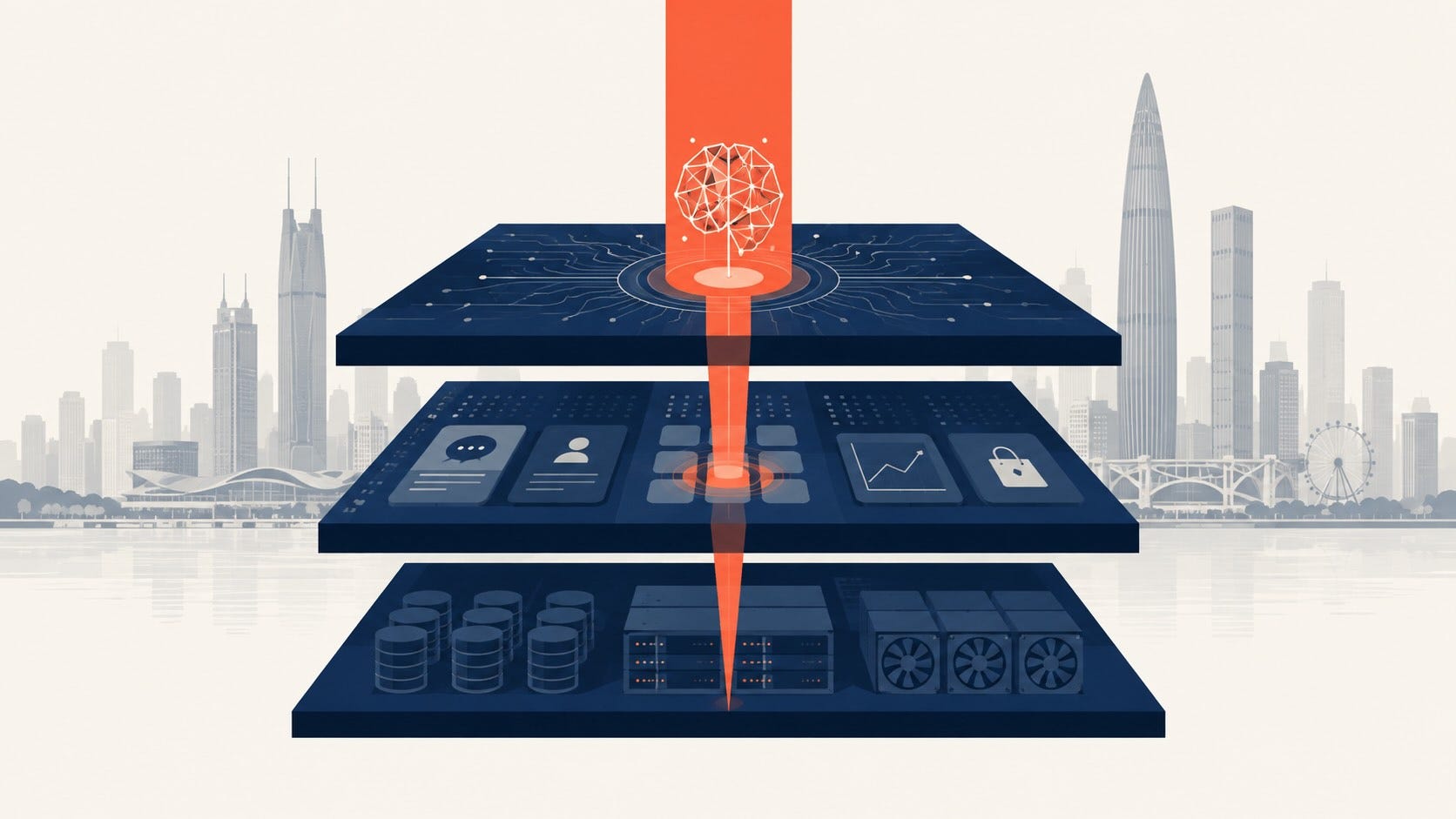
Ma Huateng, chairman and CEO, framed the strategy in Q2 as a three-layer effort. Intelligence covers the models. Applications cover the products. Infrastructure covers the compute. The framing first appeared in the Q1 disclosure. Q2 gives investors the first full quarter of costed execution against that plan.
Capex at RMB52.8B, net cash halved in one quarter
Capital expenditure reached RMB52.8B in Q2 2026, up 176% YoY and 65% QoQ, according to Tencent. The press release defines the line as IT infrastructure, data centres, and property, excluding media content. Management cited operating capex of RMB51.8B, up 190% YoY, on the call, using a slightly different definition.
Free cash flow turned negative at RMB13.8B. Excluding prepayments for compute procurement, free cash flow would have been positive RMB37.6B. Tencent chose to publish both numbers. The disclosure quantifies the wedge that AI spending is creating in the cash statements.
The P&L drag is now cleanly disclosed. Non-IFRS operating profit blended came in at RMB75.6B, up 9% YoY. Excluding new AI products, non-IFRS operating profit was RMB86.1B, up 19% YoY.
The gap is RMB10.5B in Q2, from RMB8.8B in Q1. The absolute drag is widening. The relative gap tracks Q1 closely: 10 percentage points between blended and ex-AI growth in Q2, versus about 8 points in Q1.
Operating margins diverge along the same axis. Blended margin was 37%, down from 38% a year earlier. Ex-AI margin was 42%, up from 39%. The core business is expanding margins. The AI bucket is holding total margins back by roughly five points.
The balance sheet moved sharply. Net cash fell to RMB58.2B from RMB146.9B at the end of Q1, per Tencent. Capital expenditure payments of RMB59.3B and 2025 dividend payments of RMB41.6B drove the drop. Tencent’s net cash cushion halved in one quarter.
Market reaction was negative. Tencent’s ADR fell 5.34% on results day. The Hong Kong-listed shares are down roughly 26% year-to-date, according to CNBC. Investor patience has a shorter clock than the compute build-out.
Marketing Services and cloud already monetize AI
One AI story is the RMB10.5B loss bucket. The other AI story is already earning money.
Marketing Services revenue reached RMB43.6B, up 22% YoY, per Tencent. Growth came from three explicit AI mechanics. An AI-driven ad recommendation model selects the ad shown to each user for each impression.
Upgrades to the AIM+ automated campaign management solution helped advertisers purchase performant impressions. Closed-loop marketing capabilities inside the Weixin ecosystem let Mini Games and Mini Shops advertise more effectively on Tencent-managed properties.
AIM+ was extended in Q2 with AI-powered end-to-end execution for mini shop and mini drama advertisers. The upgrade targets small-merchant campaign automation. Full-funnel creative and targeting can now be assembled with limited human ad-ops involvement.
Cloud revenue growth also accelerated. Tencent Cloud growth moved from the high teens percent range in Q1 to the low 20s percent in Q2. James Mitchell, chief strategy officer, disclosed the range on the earnings call.
Drivers were AI-related demand, international expansion, and a firmer pricing environment. Mitchell said Tencent Cloud raised prices across the board in May and cut discount rates.
Paying users of WorkBuddy already generate gross margins comparable to Tencent Cloud overall, according to Mitchell. Of the few concrete unit-economics data points Tencent has released on any new AI product, this is one. Pricing is not WorkBuddy’s constraint. Scale is.
Video Accounts, the short-video product inside Weixin, saw total time spent grow more than 20% YoY. A new multi-variable content ranking system, upgraded interactive features, and enriched content for younger users all contributed. Content ranking is where recommendation AI operates directly against user retention.
AI inside existing businesses is accretive today. The new AI products bucket is a separate P&L bet, held inside a designated envelope.
WorkBuddy inherits the capital, Hy3 supplies the tokens
According to Analysys, WorkBuddy leads Chinese PC-based AI-native office agents by monthly interactions as of June 2026. The metric is a leadership claim Tencent has cited in both Q1 and Q2. Ma described WorkBuddy as “achieving breakout user growth” and a clear leader in China today.
Internal capital followed the metric. On the Q2 call, Mitchell said Q1’s roughly RMB8B in new AI products spend and Q2’s RMB10.5B were allocated very differently, per the earnings call. Once Tencent identified WorkBuddy as breaking out, budget was aggressively shifted toward it. Other products in the new AI portfolio were deprioritized.
The AI envelope stayed disciplined. The bet inside it narrowed.
WorkBuddy’s architecture is model-agnostic. Users see GLM, Kimi, and DeepSeek available alongside Hy inside the app. Martin Lau, president, framed Hy3 as WorkBuddy’s potential primary model if it can solve most user problems cost-effectively.
Hy3 does not have to be the only model. Product-first thinking sits above model-first thinking in Tencent’s stack.
Tencent identifies WorkBuddy’s moat as harness engineering, model breadth, and its Skills library, per the press release. Leading Chinese AI labs increasingly have their own strategic incentive to build agent applications.
Bernstein’s Zhu pressed management on the point during Q&A. Lau’s response was that WorkBuddy’s product depth and third-party model access make it defensible against pure-play lab apps. WorkBuddy’s Analysys leadership will face pressure through Q3 and Q4 as labs launch first-party productivity agents.
The model behind the bet is Hy3, Tencent’s Hunyuan family model released in preview in April and in production version in July 2026.
According to OpenRouter as cited by Tencent, Hy3 production has ranked among the top 3 models globally by token consumption since 7 July 2026. Preview Hy3 was ranked first on OpenRouter starting 28 April, per Tencent’s Q1 disclosure.
Average daily token usage on Hy3 rose sixfold with the production release, per management on the call. Hy4, a larger model, is under development for release later in 2026. Lau signaled that a Hunyuan 5 sits on the roadmap as well, according to The Register.
OpenRouter measures distribution to developers routing API calls through its platform, not underlying model capability. Ranking there reflects adoption and price-performance, not benchmark performance. Hy3’s OpenRouter position is a real signal on developer economics. The ranking is not evidence of state-of-the-art capability. Lau himself framed state-of-the-art as a future milestone for the Hunyuan family.
The 30% profit Tencent is choosing to forgo
The RMB10.5B loss sits inside the new AI products bucket, separate from the AI-driven revenue growth in Marketing Services and cloud discussed above. Even so, the loss itself was not the Q2 call’s most consequential disclosure. The forgone alternative was.
Bernstein analyst Robin Zhu asked when Tencent’s Q2 capex would generate returns. Mitchell said demand for compute is strong enough that Tencent could recover depreciation “almost immediately” by renting infrastructure to third parties. Lau went further. Offers in hand would generate “more than 30 percent profit” over Tencent’s own cost from months ago, Lau said on the earnings call.
Tencent is choosing to absorb the RMB10.5B new AI products loss rather than rent out its compute capacity at 30%-plus margins available today. Absorbing the loss over renting the capacity is a revealed preference for owning the intelligence and application layers. The loss is not a failure of monetization at the infrastructure layer.
Lau’s own framing was direct. Tencent could rent, “achieve a decent return in an immediate timeframe,” and become a landlord for GPUs. Instead, the compute serves Hy model training, then WorkBuddy inference, then Weixin AI initiatives, and last, external cloud demand. That sequence names where management sees the highest long-term return.
The US hyperscaler capex debate through 2025 and 2026 is the closest analogue. Meta, Microsoft, Google, and Amazon are running similar allocation trade-offs on a larger absolute scale. Tencent’s balance sheet is smaller. The company also carries a more compressed monetization window before investor patience prices in doubt.
Lau’s answer to that pressure was mostly duration. He described the AI investment as a lump-sum outlay rather than a recurring annual burden. The measure is Tencent’s full balance sheet including cash, investment portfolio, and debt capacity, per Lau on the earnings call. The envelope extends past Q2’s RMB10.5B. Its true limit is what Tencent can afford to spend before returns arrive.
Three KPIs Q3 must move on
Whether Tencent describes it this way or not, the three-layer strategy is now a KPI framework.
Intelligence layer test: whether Hy3 token growth converts to Tencent Cloud revenue. Mitchell already flagged cloud revenue accelerating into the low 20s percent range on AI-related demand. Q3 will show whether Hy3’s OpenRouter position and the sixfold token increase translate to material third-party cloud spend, or remain a developer-adoption story.
Application layer test: whether WorkBuddy’s Analysys leadership in monthly interactions translates to enterprise contract value. Mitchell’s Q2 margin disclosure is the strongest unit-economics signal so far. The scale question sits underneath.
Infrastructure layer test: whether the RMB10.5B drag stops widening. Q1 was RMB8.8B. Q2 was RMB10.5B. A Q3 reading that meaningfully accelerates the widening would put pressure on the envelope framing. A print at or below Q2’s RMB10.5B would validate management’s internal reallocation discipline.
Beyond the three layers, Xiaowei is the next Weixin leg to watch. The agent is in small-scale prototype testing. WeLM, a custom model, powers it. Lau said WeLM is designed for privacy, cost efficiency, and Weixin-native execution.
His comparison was that AI-enabling Weixin could multiply its value the way Weixin multiplied QQ’s value in the mobile-era transition. Xiaowei’s monetization mechanics have not been disclosed. The 1.44B combined Weixin and WeChat MAU is the potential surface.
Tencent has priced the option and named the winners inside its portfolio. The Q3 and Q4 tests are cleaner than the Q2 disclosure. Whether Hy3 token growth becomes Cloud revenue. Whether WorkBuddy’s usage lead becomes enterprise contract value. Whether the RMB10.5B drag stops widening. The envelope is defined. The conversion has a deadline.