
WeChat's Xiaowei agent is a defensive bet, not a toll booth
Tencent WeChat’s Xiaowei entered beta on June 20 with a WeLM-plus-DeepSeek stack and 13 launch partners. Chinese commentary reads it as an offensive bet against advertising revenue.
Xiaowei entered closed beta June 20, 2026; public rollout targeted for Q3
WeChat’s ad revenue grew 20% YoY to RMB 38.2B in Q1 2026; cannibalization thesis fails the data test
MCP architecture lets merchants control the API surface; extraction ceiling is structurally low
Disclosed AI drag of RMB 8.8B sits inside free cash flow of RMB 56.7B; runway is years, not quarters
Falsification test: a Xiaowei-specific merchant commission would prove this analysis wrong
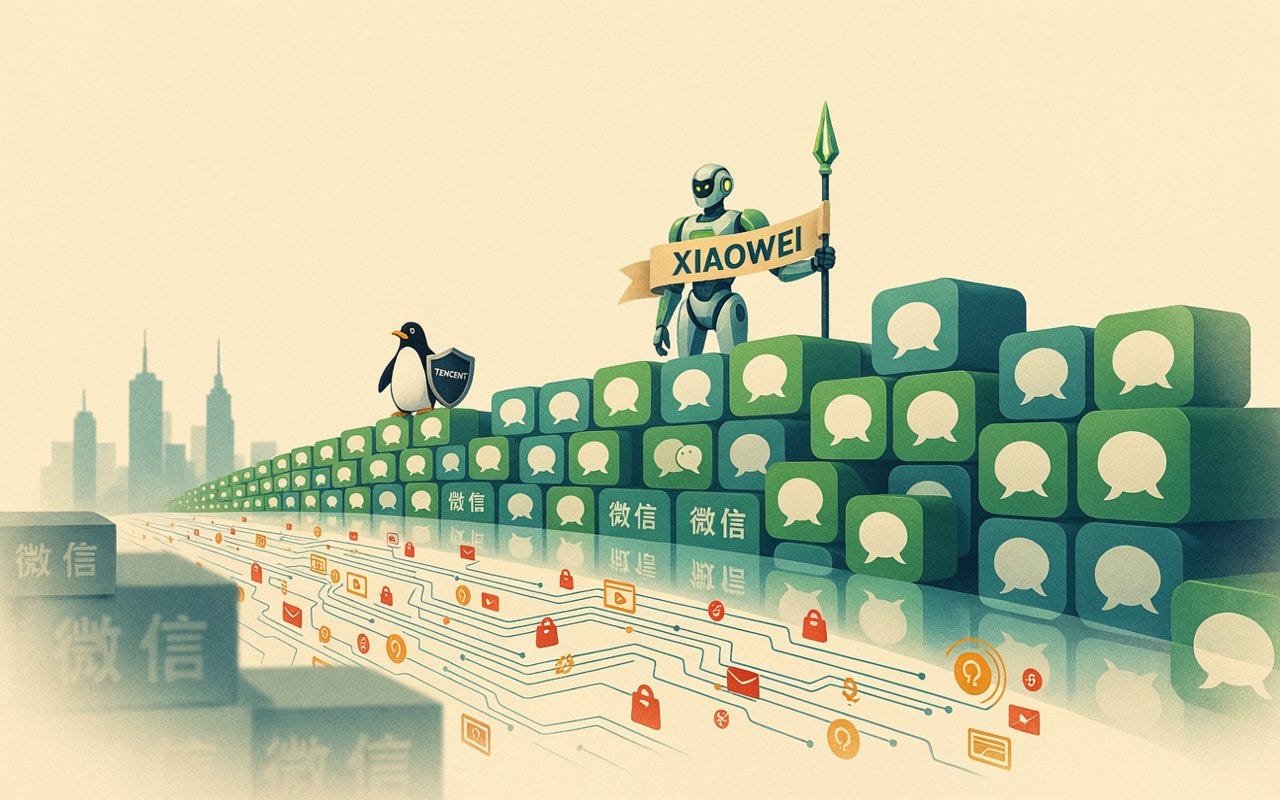
Xiaowei is a native AI assistant inside WeChat, known as Weixin in mainland China. Users see a small green robot icon at the top-left of the message list. The interface accepts text or voice.
The stack combines WeLM, a model built by the WeChat team, with DeepSeek for supplementary reasoning. Tencent’s customer service confirmed the beta rollout on June 20, 2026, according to CNBC.
Combined monthly active users of Weixin and WeChat reached 1.4 billion at the end of Q1 2026, according to Tencent. Launch partners include JD.com, Meituan, Ctrip, KFC, and Dewu. The 13 initial merchants connect to Xiaowei through Model Context Protocol wrappers rather than screen-scraping, according to Pandaily.
ByteDance’s Doubao agent uses simulated clicks on third-party apps for comparable functionality. Doubao faced merchant resistance during rollout for that reason, per Pandaily.
Tencent has not disclosed take-rates, ranking rules, or a commercialization timeline for Xiaowei. The analysis below extrapolates from architectural choices and adjacent financial disclosures.
Cannibalization thesis fails the Q1 2026 data test
Chinese commentary in Growthbox and 36Kr frames agent adoption as a slow dismantling of WeChat’s advertising toll booth. The logic runs clean. Agents complete tasks without users browsing feeds. Ad inventory contracts. Ad revenue erodes.
The Q1 2026 numbers say otherwise. Marketing services revenue grew 20% year-on-year to RMB 38.2B, accelerating from 17% in Q4 2025, according to Tencent. Management credited an upgraded AI-driven ad recommendation model and expanded closed-loop marketing inside the Weixin ecosystem.
Closed-loop marketing keeps the entire purchase journey inside WeChat. Discovery, click-through, transaction, post-purchase engagement all monetize on the same platform. The 20% growth reflects Tencent capturing more of that stack, not less.
Video Accounts ad load holds at 4-5% by management disclosure on the Q1 call. Monetization headroom inside WeChat’s existing surface is substantial. Agent-era erosion is not yet the binding constraint.
Xiaowei sits in closed beta. A Q3 2026 public rollout cannot materially dilute browsing volume in FY 2026. The Chinese cannibalization thesis is directionally coherent on a five-year view. Over the next four quarters, the numbers show acceleration.
Advertising is expanding faster than any plausible agent-era erosion. The cash flow that funds Xiaowei’s compute burn expands with it. The consensus framing inverts the sequence and mistakes long-run risk for near-term dynamic.
Xiaowei is defense against Doubao, not offense against ads
Agents in general are not the threat. Agents built by rivals that treat WeChat as commoditized infrastructure are.
ByteDance’s Doubao (a.k.a. Dola outside China) operates through screen recognition and simulated clicks on third-party apps, per Pandaily.
