
Tencent’s AI gamble runs through WeChat
Tencent is no longer trying to build China’s smartest model. The goal is to become the layer every AI agent must call to reach real-world services. WeChat’s 1.4B users are the moat.
Three AI announcements on June 2 lifted Tencent HK shares over 10%.
Tencent is repositioning as a connector layer, not a model champion.
Q1 2026 capex hit RMB31.9B, ~42% of Non-IFRS operating profit.
The launch of a WeChat AI agent now hinges on regulatory approval.
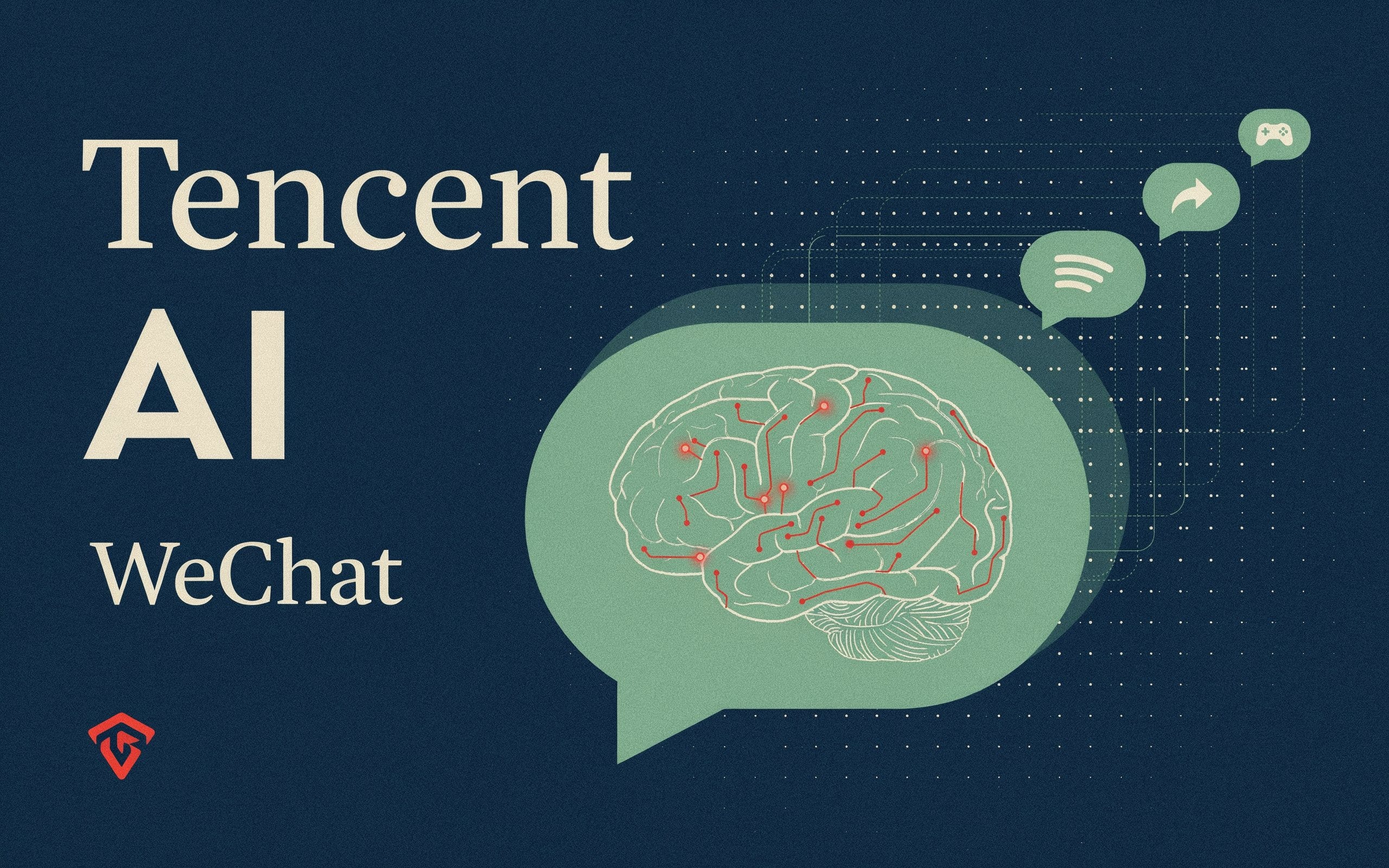
A company known for moving slowly does not usually post its biggest market move in five years. Tencent did exactly that on June 2. Three separate pieces of AI news landed within hours of each other.
WeChat is the context that makes the move matter. The app carries roughly 1.4B monthly active users. It anchors social messaging, payments, transport, and daily services across China. Each new WeChat entry point has historically faced careful internal review.
The caution is what makes the current stance notable. Tencent spent much of the past decade weighing AI bets carefully. The June 2 announcements suggest a different stance. The company now appears willing to open WeChat to outside systems rather than guard it.
The three items, taken alone, look like routine product updates. Read together against the past year, they trace a clear strategic turn. Tencent is repositioning itself as a connector, not a model champion.
Why Tencent refuses the scale war
The logic starts with a market Tencent has decided not to fight head-on. Rivals already lead the contest for standalone AI apps.
ByteDance’s Doubao has passed 340M monthly active users. Alibaba’s Qwen is bound tightly into Taobao and Alipay to build what the company calls a consumer agent. Both firms are escalating their fight over the consumer AI entry point.

Tencent’s own assistant, Yuanbao, has crossed 100M monthly active users. Closing the gap with Doubao or Qwen would mean a costly user-acquisition war on someone else’s terms.
Tencent chose a different surface. Instead of competing on app downloads, it is leaning on WeChat’s installed base. A super-app of 1.4B users reaches scenarios no standalone assistant can match.
The asymmetry is the strategy. Alibaba and ByteDance try to route around WeChat. Tencent’s plan is to make WeChat the thing they cannot route around.
Capex and org chart back the shift
The financial commitment confirms the shift is more than messaging. Tencent has steadily raised its AI outlay.
Full-year 2025 R&D spending reached RMB85.75B, up 21% YoY, with about RMB18B tied to AI. Capital expenditure for the year hit RMB79.2B, a record. First-quarter 2026 capex then climbed to RMB31.9B, nearly all of it directed at AI compute and model work. Leadership has said AI investment will at least double in 2026.
The organizational changes are sharper signals than the budget lines. In December 2025, Tencent created an AI Infra unit, an AI Data unit, and a data computing platform unit.
It also hired Yao Shunyu, a core researcher recruited from OpenAI, as Chief AI Scientist. Yao reports directly to President Liu Chiping. A reporting line straight to the president is unusual inside a major Chinese tech firm. Senior technical leaders normally sit within a specific business group.
Yao also leads the AI Infra unit and the large language model department. The dual role is meant to fuse algorithms and compute under one owner. Tencent calls the approach a co-design model tuned to its own business scenarios.
The clearest break came in March 2026. Tencent dissolved its AI Lab after nearly a decade. The move shifted AI work from research exploration toward commercial delivery. Folding a nearly decade-old research unit into commercial teams marks a compressed product timeline.
The Hunyuan reset points at agents
Tencent’s own model strategy looked defensive a year ago. After DeepSeek surged in early 2025, Tencent embraced it and lowered the priority of its in-house Hunyuan model. External readings at the time called it a concession in the model race.
After Yao’s arrival in December 2025, Hunyuan was rebuilt from the ground up across pretraining, reinforcement learning, and infrastructure.
The output landed in late April 2026. Tencent released and open-sourced the Hy3 preview model, carrying 295B total parameters and only 21B active parameters on a mixture-of-experts architecture.
The design choices matter more than the headline size. The roughly 7% activation rate favors inference cost and latency, the constraints that matter for tool-calling loops and multi-step agent runs. Hy3 is tuned for reasoning, long context, tool calling, and agent scenarios. The architecture choice points the model at agents, not at benchmark wins.
Adoption followed quickly. According to OpenRouter data cited in early reporting, Hy3 token volume rose to roughly 10 times the prior generation. The model topped OpenRouter’s weekly overall ranking for three consecutive weeks. Ma Huateng told shareholders that “after the new model trained, my confidence has grown stronger.”
WeChat as connector, not fortress
Tencent’s AI products resolve into a single layered system. Tencent is stacking its AI assets rather than betting on any one of them.
Hunyuan sits at the base as the model foundation. Yuanbao serves as the general consumer assistant. A planned WeChat AI agent acts as the ecosystem execution hub. WorkBuddy serves the enterprise productivity layer. Agent-to-agent links, known as A2A, form the connective channel across platforms.
The three June 2 announcements are proof of that doctrine in motion.
